Margins are made while the project runs

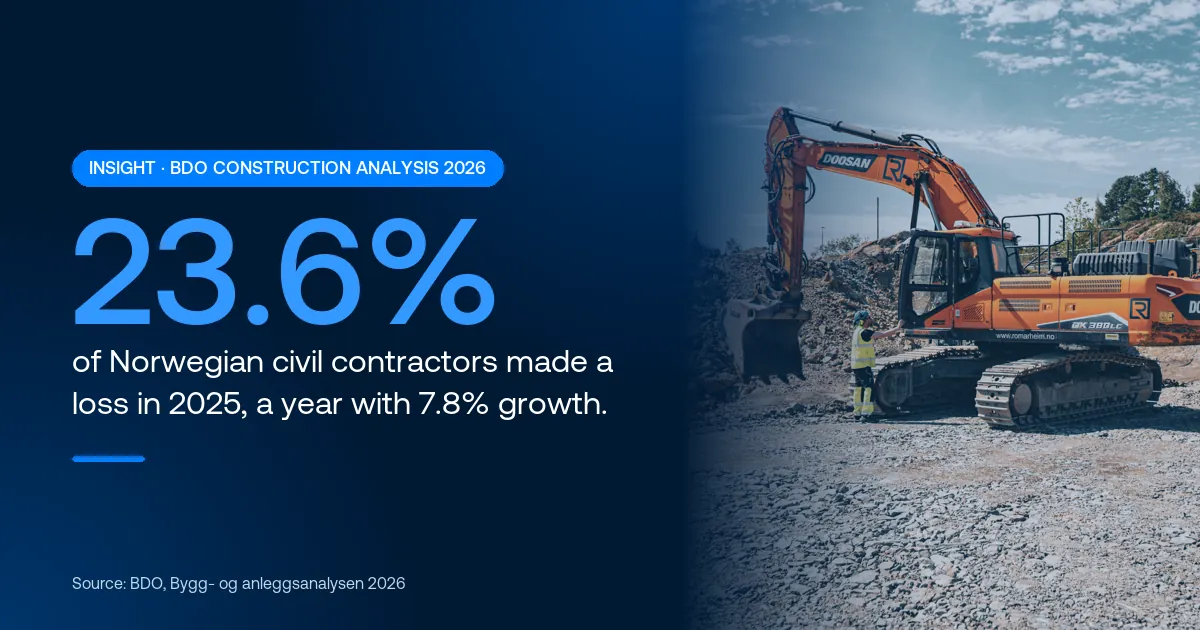
Ditio CEO Kristian Brakvatne has gone through BDO’s Bygg- og anleggsanalysen 2026, an annual analysis of the Norwegian building and civil construction value chain. Here is his take on what the numbers mean for contractors.
Key takeaways
- Norway’s civil construction sector grew 7.8 percent in 2025, but the share of civil contractors making a loss rose from 18.7 to 23.6 percent.
- Since 2021 the industry has invested more and hired more people, without getting correspondingly more back.
- With work packages, the project manager sees productivity per package day by day, while there is still time to act on it.
The Norwegian civil construction sector grew 7.8 percent last year. The operating margin rose from 3.8 to 4.4 percent. On the surface, 2025 was a good year.
Below the surface, the picture is different. According to BDO’s Bygg- og anleggsanalysen 2026, the median margin among civil contractors fell to 4.2 percent, and the share of companies making a loss rose from 18.7 to 23.6 percent. Almost one in four civil construction companies lost money in a year of growth. That was the steepest jump in the entire value chain.
The improvement came for a few. For most, 2025 was another year where more work did not pay more.
I think the numbers say something important about where the margin is actually decided. But it is not decided in the estimate alone.
The machines are bought. Now the hours have to count.
Three findings from the analysis are connected.
64%
growth in fixed assets in civil construction since 2021, to NOK 53 billion
3.1%
drop in value added per employee across the value chain since 2021, fixed prices
2.5%
operating margin among the largest civil contractors
The first is capital. Fixed assets in civil construction have grown 64 percent since 2021, to NOK 53 billion. Total tied-up capital equals 42 percent of revenue. A larger share of the machinery is debt-financed than before, and supplier credit is gone. Customers pay after 54 days, suppliers are paid after 53.
The second is productivity. Across the value chain, value added per employee has fallen 3.1 percent in fixed prices since 2021. Wages now make up 81 percent of value added, up from 77 percent in 2021.
The third is the margin. Even among the largest civil contractors, the operating margin is only 2.5 percent.
Put together: the industry has invested more and hired more people, without getting correspondingly more back. BDO says it plainly in the foreword:
“Over four years, the industry has invested more and hired more people without getting more back for it.”
BDO, Bygg- og anleggsanalysen 2026
With margins this thin, it does not take much. A few weeks of waiting for materials, the wrong sequence in production, a machine standing idle, or a crew producing slightly slower than the estimate assumed. None of it looks dramatic when it happens. Added up, it can be the entire margin.
When the machines are already bought, productivity becomes decisive. How much each labour hour and each machine hour actually produces.
The problem is not a lack of data
It is easy to think the answer is more reporting. It is not.
Most contractors have plenty of data. Timesheets, machine hours, site diaries, invoices, quantity settlements. The problem is that the data is collected to pay wages and send invoices, not to manage production. And it is put together too late.
When the post-calculation is done, you know exactly what went wrong. But by then the project is delivered, the people have moved on and the margin is gone.
The question is not whether you find out what productivity was. The question is whether you find out while you can still do something about it.
What is a work package, really?
The principle is simple. The project is split into defined work packages, taken from the estimate and the schedule. Each package has a quantity to be produced, such as metres of trench or cubic metres of material, and a budget in hours to produce it. Every day, labour hours and machine hours are registered against the package they actually went to, together with what was produced. That lets you see productivity per package, day by day, while the work is under way.
A simplified worked example with illustrative figures
A package is 400 metres of water and sewer trench with a budget of 1,200 hours. That is three hours per metre.
3.0 h/m
Budget: 1,200 hours for 400 metres
4.0 h/m
After two weeks: 480 hours for 120 metres
1,600 h
Forecast for the package: 400 hours over
After two weeks, 120 metres are laid and 480 hours used. That is four hours per metre. If it continues like this, the package ends at 1,600 hours. 400 hours over budget, a third more than the estimate.
With work packages, the project manager sees that the pace is off after just a few days, and has it confirmed in week two. At that point there are still 280 metres left to influence. Maybe the ground conditions are worse than expected. Then the client must be notified in time, and the hours and metres per day provide important documentation for the claim. Maybe the crew is waiting for materials, and that is a logistics problem. Maybe it is the wrong machine for the job. Either way, something can be done.
Water and sewer trench: hours vs metres
Without work packages, they see it in the post-calculation.
That is the whole difference. Not more data. Data in time for someone to act on it.
This is what we are building at Ditio
That is why we at Ditio are now building work packages into the core of the product.
The goal is to connect the estimate and the plan directly to the hours, machine hours and quantities registered in the field. Not as a separate report produced afterwards, but as part of the daily registration that is already being done.
We do it because this is where we as a supplier can make the biggest difference. Not by saving a few clicks in an app, but by giving project management a better basis for making the operation itself more productive.
Easier said than done
What we see from customers who come to Ditio from paper, spreadsheets or other systems is that they are used to registering hours after the fact. We often hear things like “we do our registration on Friday for the whole week”. The problem is that it becomes a best-effort reconstruction, not a real-time registration. In those cases the numbers are worthless for management. How well do you really remember what you had for dinner three days ago? In Ditio, hours are registered out on site the same day, and that is what makes them useful for management.
The quantities are missing. Hours are easy to register because they have to be paid. Metres and cubic metres produced are usually measured once a month, for the progress payment, and for the project as a whole. That is enough for invoicing, but not for seeing that one crew is behind on one package. Without quantities per package there is no productivity to measure, only consumption.
And more fields make it worse. Every extra thing to fill in on a phone out in the trench reduces the chance that anything gets filled in correctly.
The answer is to get the quantities from where they already exist, and only ask for the rest. Much of what is produced is already measured. Machine control logs what has been dug and laid, the surveyors measure completed work, and loads of material are counted. What cannot be collected automatically, the foreman registers once a day per package, in the same place as the hours. “42 metres laid today.” One number, not a form.
I cannot promise that work packages will lift the margin by a specific number of percentage points. What I can say is that you cannot manage a productivity you only get to see once the project is finished. Registration has to happen where the work is done, the same day, with as few fields as possible. Otherwise it is just a more expensive post-calculation.
Data first, AI second
BDO has a dedicated chapter on artificial intelligence. Four in ten companies have invested in AI, compared with fewer than two in ten a year ago. Two in three of them are seeing benefits.
But the conclusion is sober. The benefit depends more on whether the company has its data in order than on which tools it uses. For contractors, BDO points to areas such as deviation reporting, machine operations and project management.
It is worth being precise here: AI cannot calculate productivity when hours and quantities were never registered against the same package. It cannot find patterns in hours logged to the wrong project, or compare quantities that do not exist.
Work packages are therefore not just a management tool for today. They are the structure that makes it possible to learn across projects tomorrow. Which packages tend to overrun, under which conditions, and how early the signal came.
The margin is decided out on site
The industry spends a lot of energy on winning the right projects and pricing the risk correctly. That matters.
But BDO’s numbers show that it is not enough. With thin margins, capital tied up in machinery and falling value added per employee, the result is decided after the contract is signed. Out on site, hour by hour.
The post-calculation tells you what happened. It cannot change it.
Margins are made while the project runs.
Frequently asked questions about margins and work packages
Why did so many civil construction companies make a loss in 2025?
According to BDO’s Bygg- og anleggsanalysen 2026, the share of Norwegian civil contractors making a loss rose from 18.7 to 23.6 percent, even though the sector grew 7.8 percent. The industry has invested more and hired more people since 2021, but value added per employee has fallen 3.1 percent. With operating margins as low as 2.5 percent, it takes very little for a project to end in the red.
What is a work package in a construction project?
A work package is a defined part of the project, taken from the estimate and the schedule. Each package has a quantity to be produced and a budget in hours to produce it, for example 400 metres of water and sewer trench in 1,200 hours. Labour hours, machine hours and quantities produced are registered daily against the package, so productivity can be tracked while the work is under way.
Why is the post-calculation not enough to protect the margin?
The post-calculation shows what went wrong only after the project is delivered. By then the people have moved on and the margin is gone. To influence the result, deviations must be spotted while there is still work left to manage.
What does it take for AI to deliver value in construction?
BDO finds that the benefit of AI depends more on whether a company has its data in order than on which tools it uses. AI cannot calculate productivity when hours and quantities were never registered against the same package. Hours, machine hours and quantities must therefore be registered correctly, the same day, where the work is done.
Read more
Source: BDO, Bygg- og anleggsanalysen 2026. The analysis is based on the accounts of 4,545 companies in the Norwegian building and civil construction value chain for the 2025 financial year. Quotes from the report are translated by Ditio.